Location: Gaoming District, Foshan, Guangdong, China

How to Choose a Small Nursery Glider for a Compact Space

A chair can fit neatly into a nursery corner and still bump the wall when you glide or recline. If you’re shopping for a small glider chair for nursery use, measure the space the chair needs while it moves as well as the space it takes up at rest.
These five checks will help you compare models before ordering. They can also help retailers give shoppers more useful dimensions on a product page.
1. Measure the space where the chair will sit
Measure the usable width and depth of the corner. Include anything that takes up space at floor level, such as baseboards, a radiator, or the legs of a side table. Check whether a door or dresser drawer swings into the area.
Then compare those measurements with the chair’s overall width and upright depth. Overall width runs from the widest point on one side to the widest point on the other. Seat width measures the space you sit in. Both are useful when you want a chair that fits the room and feels comfortable to use.
2. Check how much room the chair needs to glide
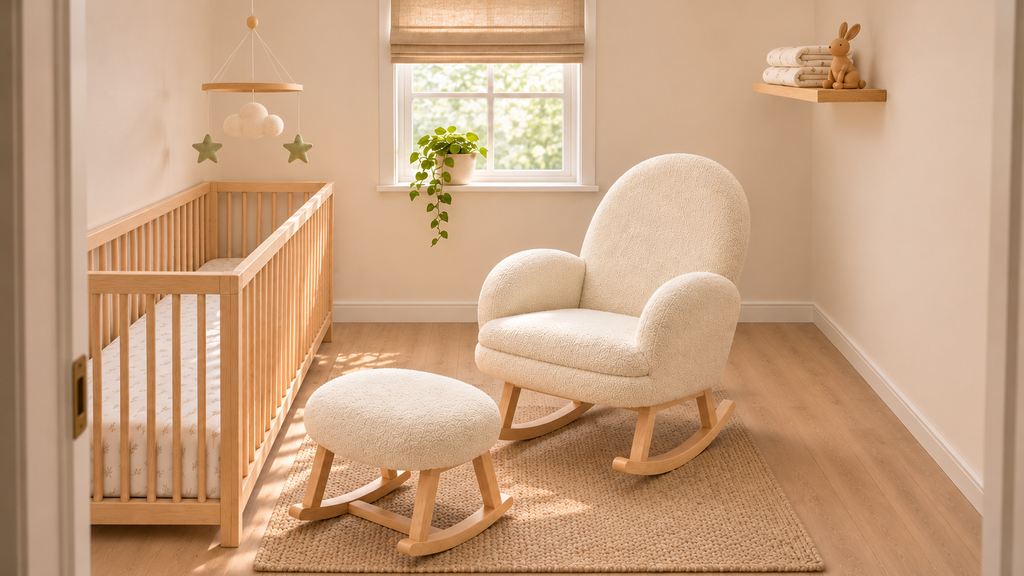
Ask for the front and rear clearance the manufacturer recommends for the specific model. If you can try a sample, sit in it and move through its full glide. Check the nearest points to the wall and surrounding furniture.
If the chair also swivels, turn it through its intended range. A padded arm that clears a side table when the chair faces forward may come closer to it as the chair turns. For a quick comparison of how gliders and traditional rockers move, see our nursery glider chair vs. rocking chair guide.
3. Measure again with the footrest extended
If you’re considering a reclining glider, ask for the overall depth with the footrest extended and the overall depth at full recline. If the chair can stop in different positions, confirm which position each measurement describes.
A side-view photo with the footrest open helps you see where it ends. Pair it with the measured depth and the recommended rear clearance. When planning the layout at home, mark the footprint on the floor with painter’s tape and check whether you still have a clear route past the chair.
4. Compare the seat and arms, too
Two chairs with similar overall widths can have different seat widths because the arms take up different amounts of space. Compare seat width, seat depth, seat height, and arm height before choosing a model.
If you can try the chair, sit back with your feet on the floor and rest your elbows on the arms. Then stand up a few times. Those simple checks can tell you whether a compact chair feels comfortable for the person who will use it regularly.
5. Make sure it can get into the room
Measure the narrowest doorway and any tight turns, stairs, or landings along the delivery route. Ask for carton dimensions and confirm which parts, if any, are packed separately. If the backrest ships detached, check the dimensions of the largest piece you’ll need to carry.
For retailers, put assembled dimensions and carton dimensions in separate fields. Shoppers can check room fit from the first set, and delivery teams can plan access from the second.
What measurements should a retailer show?
| Measurement | Why it matters |
|---|---|
| Overall width and upright depth | Shows how much floor space the chair takes up at rest |
| Seat width, depth, and height | Helps shoppers judge how the chair will fit them |
| Recommended front and rear clearance | Shows how much space the chair needs to move |
| Depth with footrest extended and at full recline, where applicable | Helps shoppers plan the layout around a reclining model |
| Carton dimensions and gross weight | Helps with delivery and handling |
Request nursery glider dimensions from Tianfeng Baby
If you’re selecting nursery seating for a U.S. retail assortment, tell Tianfeng Baby your target chair width, available floor depth, and the functions you want to offer