Location: Gaoming District, Foshan, Guangdong, China

Nursery Furniture Manufacturing Process: Inside Tianfeng Baby’s Woodworking Workshop

The nursery furniture manufacturing process involves much more than cutting wood and assembling components. Before a wooden part becomes a crib rail, chair frame, table leg or furniture panel, it may pass through several stages of sizing, shaping, drilling and sanding.
Inside Tianfeng Baby’s woodworking workshop, machinery and experienced operators work together to prepare wooden components for nursery furniture, children’s furniture and customized wooden products.
Different machines are used for different shapes and production requirements. Each stage helps prepare components for accurate assembly, smooth finishing and consistent bulk production.
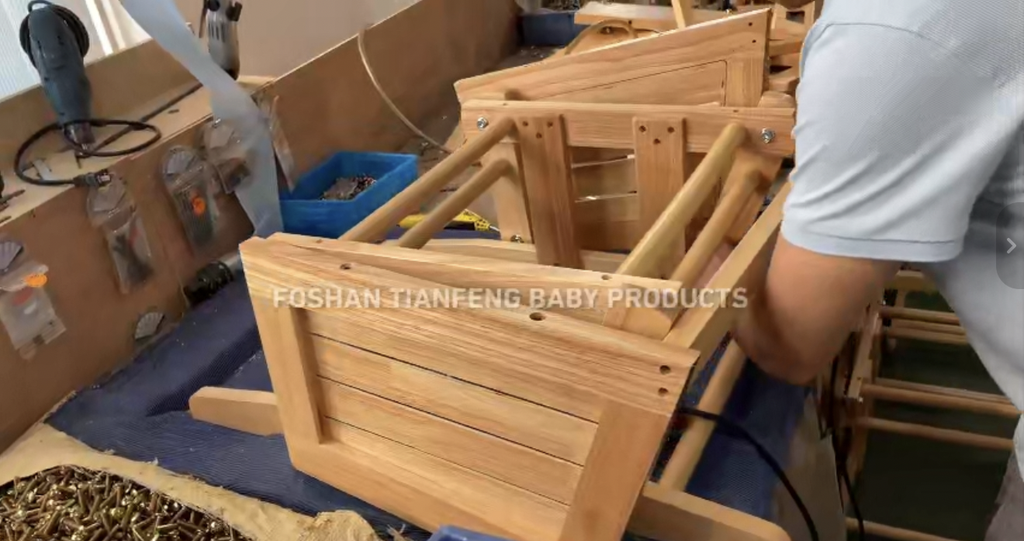
What Machines Are Used in Nursery Furniture Manufacturing?
A nursery furniture factory may use different combinations of cutting, drilling, shaping and sanding equipment depending on the product.
At Tianfeng Baby, the woodworking process shown in this factory tour includes:
- Wood cutting and component sizing
- Repeatable positioning and machining
- Multi-spindle drilling
- Shaping and edge processing
- Sanding of curved and irregular components
- Automatic through-feed sanding
- Large-frame and surface sanding
- Manual inspection between processes
No single machine completes every wooden component. A straight furniture panel, a curved chair arm and a drilled frame connector require different processing methods.
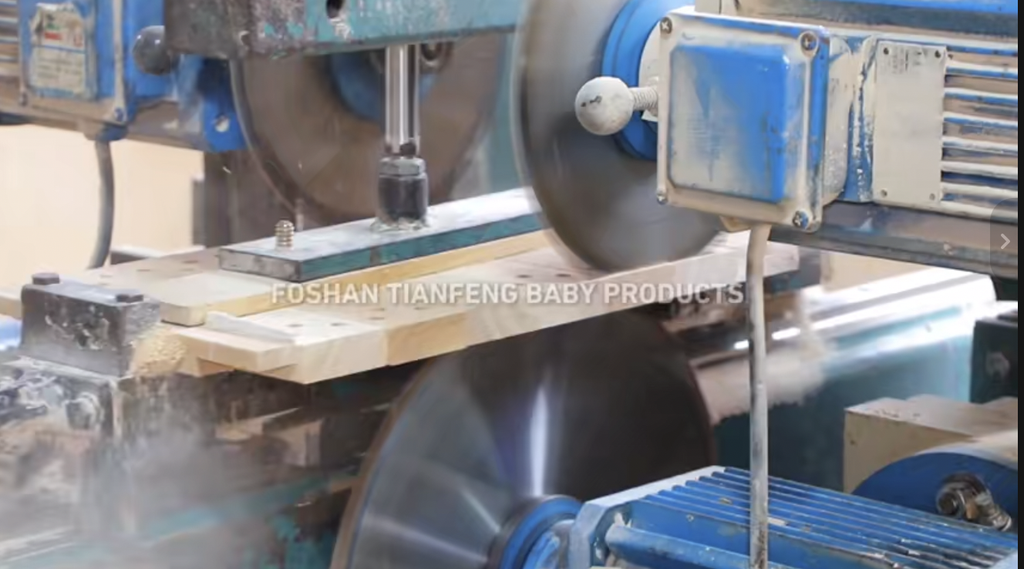
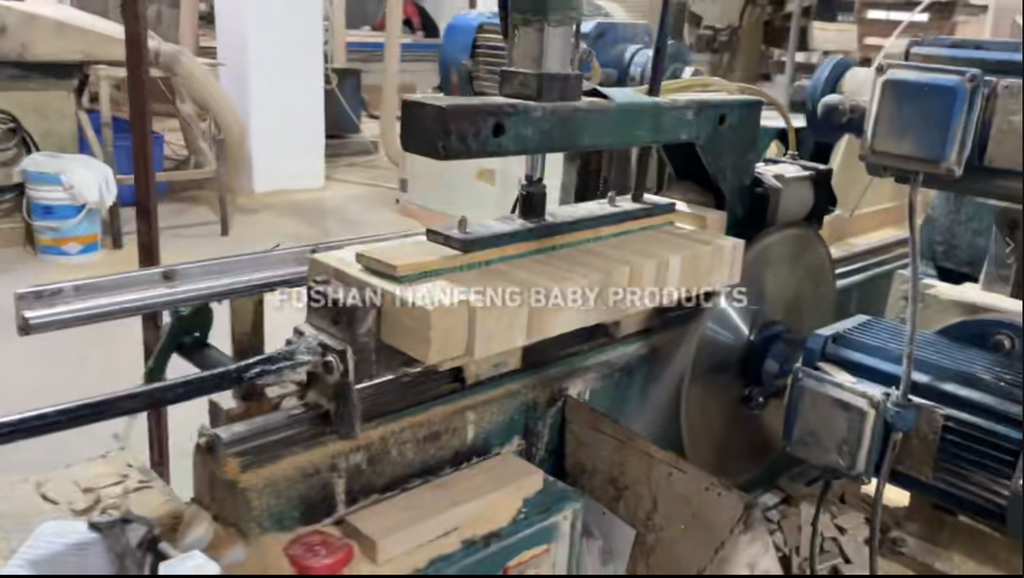
Precision Wood Cutting and Component Sizing
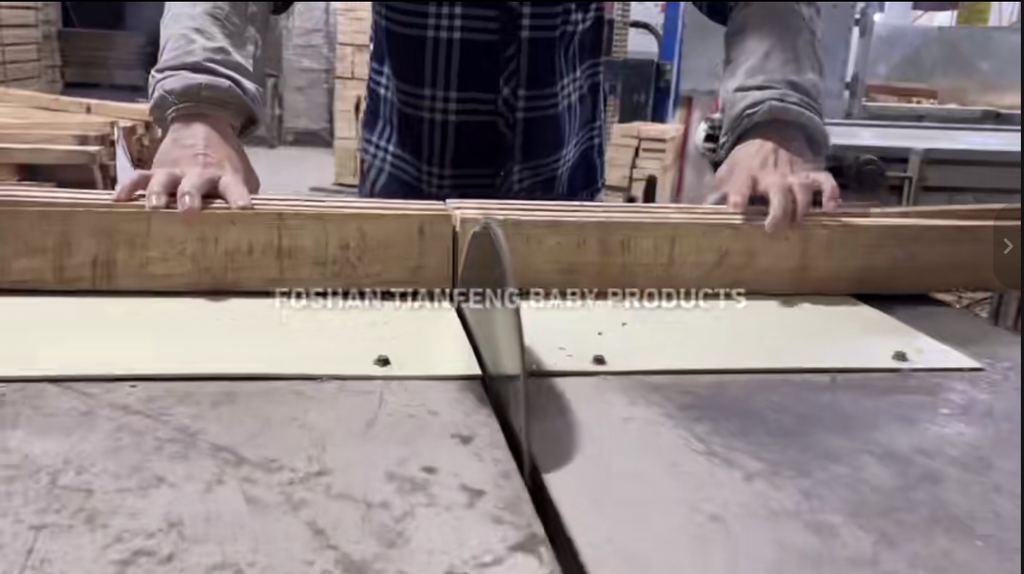
The first photographed process shows wooden components being cut and sized with circular cutting equipment.
Accurate cutting is important because the dimensions established at this stage affect later drilling, joining and assembly. If components are cut inconsistently, holes and joints may not align correctly during production.
Operators position and secure the wooden material before it enters the cutting area. The machine then removes or trims the required section according to the production setup.
This type of equipment can be used to prepare components such as:
- Wooden frame sections
- Chair and sofa supports
- Rails and crosspieces
- Table and storage components
- Parts requiring repeatable lengths
For bulk production, repeatable cutting helps different batches follow the approved product specifications.
Repeatable Positioning for Wooden Components
Another image shows an operator positioning a larger wooden component within a machine fitted with multiple supports and clamps.
Fixtures help hold the part in a consistent position during processing. This is particularly useful when several components need to be machined in the same location or when a larger wooden frame requires stable support.
Accurate positioning can help reduce variations between components and make the subsequent assembly process more predictable.
The machine setup must still be adjusted according to the product design. A nursery chair frame, crib component and children’s table will not necessarily use the same positioning or machining sequence.
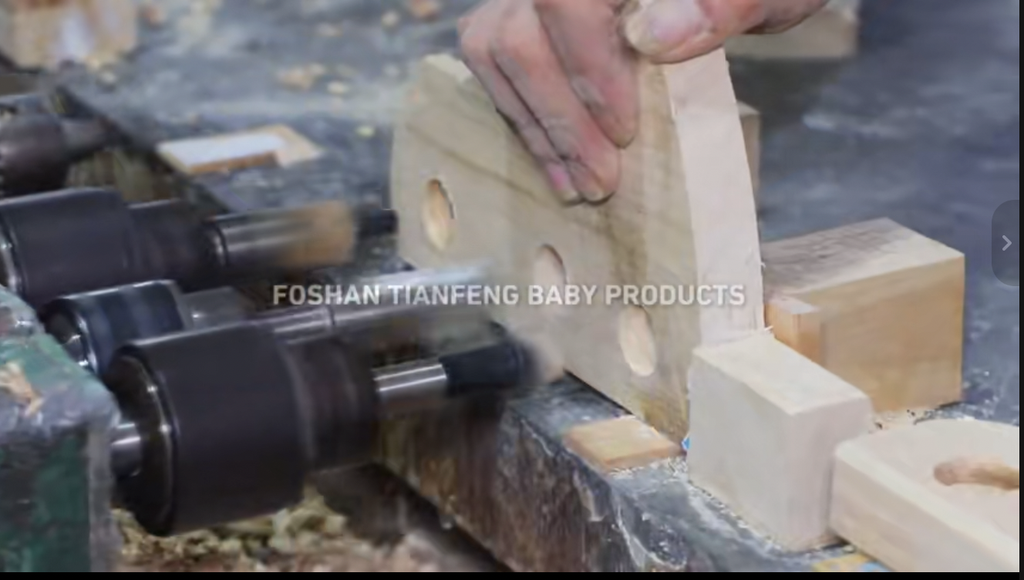
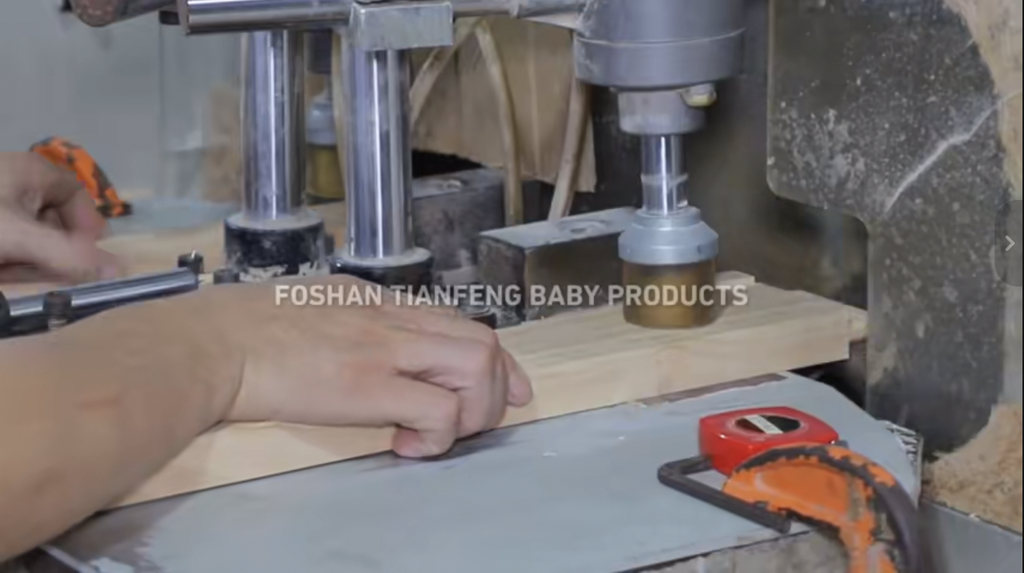
Multi-Spindle Drilling for Joinery Preparation
Drilling is an essential stage in many wooden furniture products. Holes may be required for dowels, bolts, screws, fittings or other connecting components.
The photographed multi-spindle drilling equipment can process more than one hole position during an operation. The wooden component is aligned against the fixture before the drilling heads enter the material.
Consistent hole placement matters because even a small positional difference may affect how two parts connect.
This process supports the preparation of:
- Wooden frame joints
- Dowel connections
- Hardware attachment points
- Chair and table components
- Assembly holes
- Adjustable product components
Before moving to assembly, drilled components can be checked for hole position, depth and visible material defects.
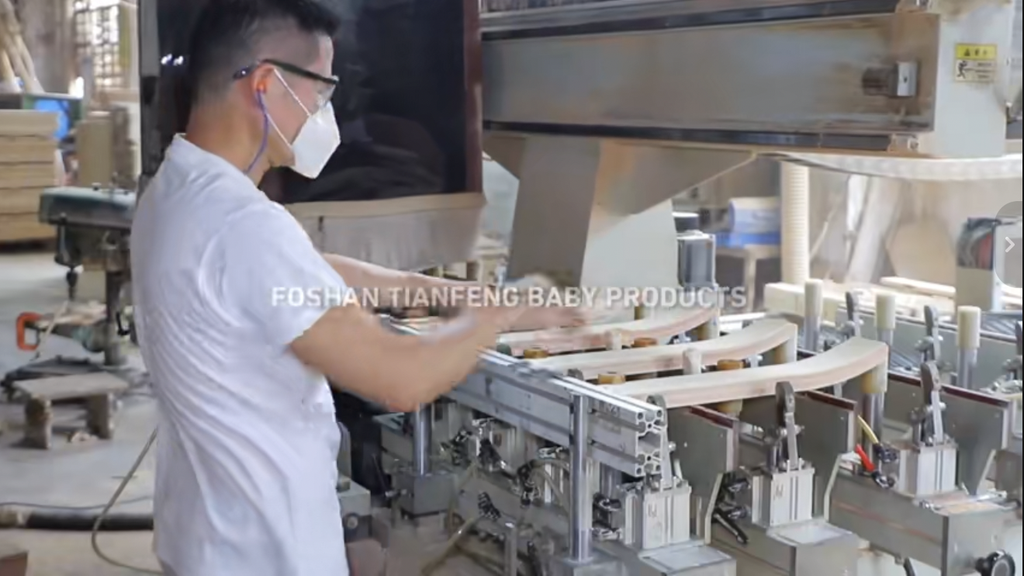
Shaping and Sanding Smaller Wood Parts
Nursery and children’s furniture often includes rounded edges, curved supports and other shapes that cannot be processed effectively with only a flat sanding machine.
The vertical sanding equipment shown in the workshop is used to work around the edge or profile of a wooden component. The operator guides the material carefully against the rotating sanding surface.
This process can help smooth:
- Curved wooden edges
- Small frame components
- Rounded corners
- Shaped supports
- Irregular component profiles
The amount of material removed must be controlled. The objective is to smooth the surface while maintaining the required dimensions and intended shape.
Rounded and well-prepared edges are especially important for products intended for nursery and children’s spaces. Final product requirements must still be evaluated according to the product category and destination market.
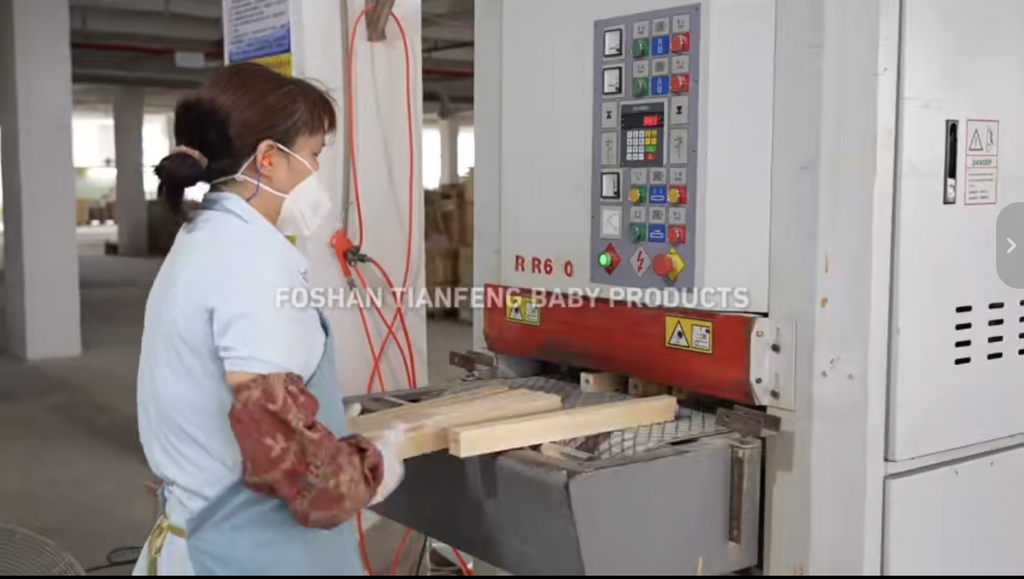
Automatic Through-Feed Sanding
The factory also uses automatic sanding equipment for wooden components that can pass through a controlled feeding system.
The operator guides the parts into the machine, where sanding heads process the exposed surfaces or profiles. Compared with sanding every suitable component entirely by hand, this method can help maintain more consistent processing across a production batch.
Automatic sanding may be used to:
- Remove machining marks
- Smooth prepared wooden surfaces
- Improve consistency between components
- Prepare wood for further finishing
- Reduce heavy manual sanding work
The machine settings depend on the material, component shape and required surface condition. Parts still need to be examined after processing because wood grain and component profiles can vary.
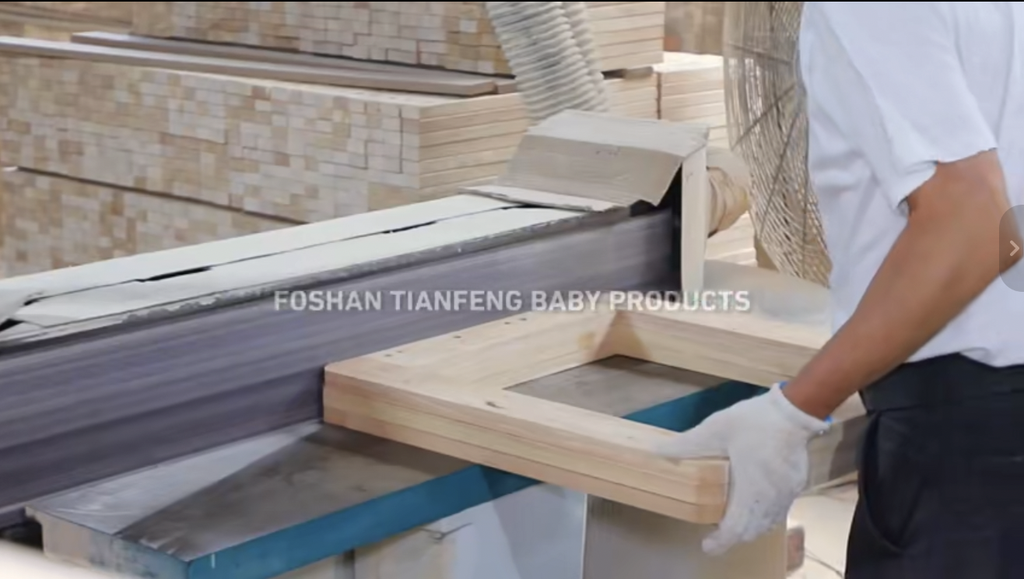
Sanding Larger Frames and Surfaces
Larger wooden frames require a different sanding method from small blocks or narrow components.
In the workshop image, the operator holds and guides a large wooden frame against a moving sanding surface. This allows broader edges and assembled shapes to be processed while the operator controls the contact area.
This step may be used for:
- Large wooden frames
- Rectangular furniture components
- Wide edges
- Joined structures
- Components requiring additional surface preparation
The operator must move the part evenly so that one area is not excessively sanded. This combination of machine movement and operator control is important when working with larger or less uniform shapes.
Why Are Several Sanding Machines Required?
Different furniture components cannot all be sanded in the same way.
A flat wooden panel has different requirements from a curved chair arm, a drilled connector or an assembled wooden frame. Using several sanding methods allows the factory to select a process suited to the shape and size of each component.
The nursery furniture manufacturing process may combine:
- Automatic sanding for suitable repeatable components
- Profile sanding for curved or irregular edges
- Belt sanding for larger surfaces and frames
- Hand sanding for corners and detailed areas
- Visual and touch inspections between stages
Multiple sanding stages may also be required before a wooden surface is ready for its intended finish.
Machinery and Experienced Operators Work Together
Woodworking machinery improves speed and repeatability, but equipment alone does not guarantee a suitable finished component.
Operators are still responsible for:
- Positioning materials correctly
- Selecting the appropriate machine setup
- Monitoring the processing operation
- Checking dimensions and hole positions
- Identifying visible material defects
- Inspecting surfaces after sanding
- Separating components that require adjustment
Natural wood and wood-based materials can vary in grain, density and surface condition. Human inspection remains important throughout production.
This is why Tianfeng Baby combines woodworking equipment with experienced production workers rather than relying on machinery without process checks.
Quality Checks Before Assembly
After cutting, drilling and sanding, components must be prepared for the next production stage.
Depending on the product, checks may include:
- Component length and width
- Hole position and depth
- Joint alignment
- Edge condition
- Surface smoothness
- Shape consistency
- Visible cracks or defects
- Correct quantity for assembly
Components that do not meet the confirmed requirements may need to be adjusted, reprocessed or replaced before assembly.
Performing checks between stages helps prevent unsuitable components from continuing further through production.
How Woodworking Machinery Supports OEM and ODM Projects
OEM and ODM nursery furniture projects may require different dimensions, shapes, materials and production methods.
For an OEM project, the factory may need to develop a wooden component according to the buyer’s drawing, reference sample or technical specification.
For an ODM project, an existing model may be customized through changes to dimensions, materials, finishes, upholstery, labels or other selected details.
Woodworking equipment supports these projects by helping the factory prepare repeatable components after the product specifications and production methods have been confirmed.
Depending on feasibility, Tianfeng Baby can develop customized:
- Nursery chair frames
- Rocking chair components
- Crib and changing-table components
- Children’s tables and chairs
- Wooden storage furniture
- Bookshelves
- Learning towers
- Wooden toys
- Other nursery and children’s wooden products
A sample is normally developed before customized products enter bulk production. The sample can then be evaluated for dimensions, construction, appearance and applicable testing requirements.
From Wood Components to Finished Furniture
Wood processing is only one part of the complete nursery furniture manufacturing process.
After the required wooden components have been prepared, later stages may include:
- Component inspection
- Frame assembly
- Surface finishing
- Upholstery preparation
- Foam and fabric application
- Hardware or mechanism installation
- Functional inspection
- Final quality control
- Labeling and packaging
The exact sequence depends on the product. An upholstered nursery recliner follows a different production route from a wooden crib, children’s bookshelf or learning tower.
Frequently Asked Questions
What machines are used to manufacture nursery furniture?
Nursery furniture production may use cutting saws, drilling machines, shaping equipment, profile sanders, belt sanders and other woodworking machinery. The equipment depends on the product material, shape and construction.
Why are multiple sanding stages necessary?
Different machines process different component shapes. Several stages may be required to remove machining marks, smooth edges and prepare surfaces for assembly or finishing.
Is all nursery furniture sanded by machine?
No. Machinery can process many surfaces efficiently, but manual sanding may still be required for corners, curved details and areas that cannot be reached effectively by larger equipment.
Does woodworking machinery guarantee product quality?
Machinery supports accuracy and repeatability, but quality also depends on machine setup, operator experience, material selection, inspection and production control.
Can Tianfeng Baby manufacture customized wooden products?
Yes. Tianfeng Baby can discuss customized nursery furniture, children’s furniture and wooden toy projects based on the buyer’s design, target market, expected quantity and product requirements.
Can a sample be adjusted after evaluation?
Yes. If evaluation or testing identifies an issue, the sample can be reviewed and adjusted. Depending on the modification, the revised sample may need to be evaluated or tested again.
Visit Tianfeng Baby’s Manufacturing Process
Tianfeng Baby has manufactured nursery and children’s furniture since 1996. Our production capabilities include woodworking, frame preparation, upholstery, assembly, sample development and quality control.
For OEM and ODM projects, our team can review product concepts, drawings, reference samples and customization requirements before preparing a development plan.
Contact Tianfeng Baby to discuss your custom nursery furniture, children’s furniture or wooden product project.