Location: Gaoming District, Foshan, Guangdong, China

Nursing Chair vs Lounge Chair: Which Is Best for a Nursery?

Quick Answer: Is a Nursing Chair Better Than a Lounge Chair?
A nursing chair is usually the better choice for a nursery because it is designed for feeding, holding and soothing a baby, with supportive armrests, an upright seat and often a gliding or reclining function. A lounge chair can work for occasional sitting, but it may not provide the same ergonomic support for repeated daily use with a newborn.
A nursing chair vs. lounge chair may look surprisingly similar at first glance. Both can feature soft upholstery, padded armrests, high backs, swivel bases, rocking mechanisms, or reclining functions.
But a well-designed nursing chair is much more than a comfortable lounge chair placed in a nursery.
A nursing chair is used during feeding, cuddling, soothing, late-night care, and repeated sitting and standing while holding a newborn. Mothers may also be recovering from childbirth, including Caesarean delivery.
These real-life parenting situations create a very different furniture design brief.
A good nursing chair should consider feeding posture, postpartum mobility, arm support, back and neck support, gentle motion, ease of standing, upholstery performance, and nursery safety.
In other words:
A nursing chair is not designed simply for sitting. It is designed around the everyday movements of caring for a newborn.
For nursery furniture brands, importers, wholesalers, and retailers, understanding these differences is essential when developing or sourcing a truly functional nursery chair.
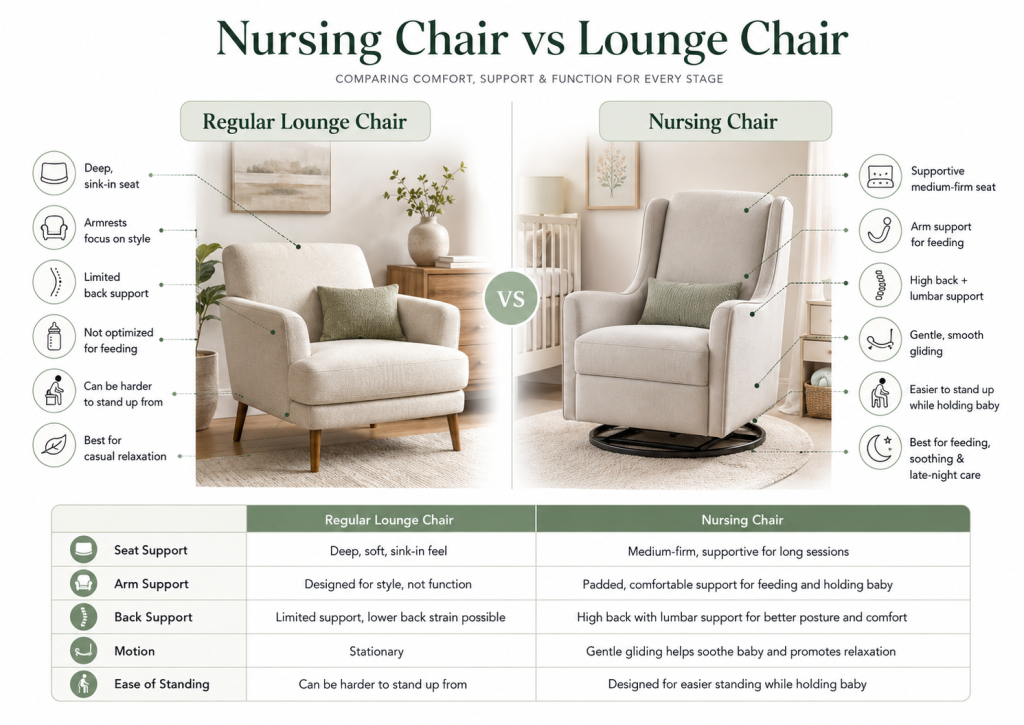
Nursing Chair vs. Lounge Chair: Why Are They So Easy to Confuse?
Many nursing chairs are developed from existing lounge chair or recliner structures.
A manufacturer may add a glider base, change the upholstery, increase the backrest height, or add a reclining function and then reposition the product for the nursery market.
From a manufacturing perspective, this approach can reduce development cost and shorten lead time.
However, simply adding a gliding mechanism does not automatically create a good nursing chair.
The key question is not:
“Does this chair rock?”
The better question is:
“Does every part of this chair support the way parents actually feed, hold, soothe, and care for a newborn?”
That difference in design thinking separates a purpose-built nursing chair from an ordinary lounge chair.
1. Nursing Chair Ergonomics Matter More Than Extreme Softness
A traditional lounge chair is often designed around relaxation.
Deep seats, thick cushions, and a soft “sink-in” feeling may feel luxurious in a living room.
For nursing use, however, excessive softness can become a disadvantage.
If the seat is extremely deep or the cushion collapses too much under body weight, the parent may sink backwards. This can make it harder to maintain a supported feeding posture and harder to stand up while holding a baby.
A well-designed nursing chair should therefore consider stable lumbar support, moderate cushion firmness, upper-back support, appropriate seat depth, and a controlled sitting angle.
The goal is not simply to make the chair softer.
The goal is to keep the body comfortably supported during a feeding or soothing session that may last for an extended period.
For B2B buyers developing a new nursery chair, foam density, seat geometry, spring structure, and backrest contour can be just as important as fabric selection.
2. Postpartum Recovery Makes Ease of Standing More Important
One of the most overlooked differences between a nursing chair and a regular lounge chair is how easily the user can get out of it.
This can be especially important during postpartum recovery.
After childbirth, and particularly after a Caesarean section, some mothers may experience abdominal soreness and reduced comfort during certain movements.
A very low, very soft, or extremely deep chair can require the user to lean far forward, reposition several times, or use significant leg and abdominal effort before standing.
That may be acceptable in an ordinary lounge chair.
It is less ideal when the user is holding a newborn.
From a furniture-design perspective, this means a nursing chair should carefully balance:
- Seat height
- Seat depth
- Cushion firmness
- Armrest position
- Backrest angle
- Overall stability
A simple prototype test can reveal a great deal.
Ask a tester to hold a weighted baby dummy, sit normally, and then stand up without changing the way the baby is held.
If the user has to rock forward several times or struggle to leave the seat, the proportions may need improvement.
A well-designed nursing chair cannot eliminate postpartum discomfort, but thoughtful geometry can help reduce unnecessary movement during everyday use.
3. Nursing Chair Armrests Should Support Feeding
On many lounge chairs, armrests primarily contribute to appearance.
On a nursing chair, armrests become part of the ergonomic system.
During feeding or soothing, the parent may support the baby’s weight with the forearms and elbows for a considerable period.
If the armrests are too low, the upper body may lean to one side.
If they are too high, the shoulders may remain raised.
If the distance between the two armrests is too wide, the user may be unable to keep the baby close while comfortably resting the arms.
For nursing-chair development, manufacturers should consider:
- Armrest height relative to the seat
- Inner distance between armrests
- Forearm-support area
- Padding thickness
- Inner armrest shape
- Edge softness and comfort
One interesting product-development opportunity is a subtle nursing arm-support zone.
Instead of creating an oversized armrest, the inner surface can be slightly curved or padded to support the forearm more naturally.
The change may be visually subtle, but the difference in daily use can be significant.
4. High-Back Support Is Valuable During Late-Night Feeding
A regular accent chair may stop around shoulder height because visual lightness is more important than full-body support.
Nursery use is different.
Parents often use nursing chairs during late-night feeding and soothing when they are already tired.
A high-back nursing chair can provide support for the lower back, upper back, shoulders, neck, and head.
This does not mean the chair must look bulky.
Modern nursing chairs can combine:
- A slim high-back profile
- Gentle lumbar shaping
- Subtle head support
- Soft side wings
- Residential upholstery styling
This creates an important design principle for modern nursery furniture:
Specialized ergonomic support does not have to look clinical.
The best nursing chairs often hide functional support inside an attractive residential silhouette.
5. A Nursery Glider Chair Should Move Gently, Not Dramatically
Rocking and swaying are commonly used by parents to comfort newborns.
But the objective of a nursery glider chair should not be to create the largest possible rocking range.
For nursery use, motion quality is generally more important than motion size.
A good glider or rocker should feel:
- Smooth
- Predictable
- Quiet
- Controlled
- Stable
Design teams should pay attention to the chair’s starting movement, resistance, rebound, mechanical noise, movement range, and change of direction.
A useful design reference is the gentle rhythm created when a caregiver softly sways or walks while holding a baby.
That is very different from exaggerated rocking.
It is also important to distinguish normal gentle soothing movement from violent shaking. Dangerous shaking of an infant can cause severe injury, while gentle rocking and swaying are commonly used as soothing behaviors.
For product developers, the lesson is straightforward:
Nursery movement should prioritize smoothness and control, not maximum amplitude.
6. The Parent and Baby Form One Ergonomic System
Traditional seating design usually evaluates one adult sitting in one chair.
Nursing furniture is more complicated.
The parent is sitting while holding and supporting another person.
This means the chair should be evaluated as an ergonomic system involving both the adult and the baby.
Designers should ask:
Where does the parent’s elbow naturally sit while feeding?
Can the baby remain close to the parent’s body while the forearm is supported?
Does the chair encourage an upright, comfortable posture rather than repeated forward bending?
Is there enough usable seat width for different feeding positions?
Can the parent reposition the baby without fighting against oversized side cushions?
Questions like these often reveal more useful design information than simply asking whether a prototype feels soft.
7. Foot Support Can Improve the Nursing Experience
Foot positioning can also affect overall sitting posture.
This is one reason traditional nursing gliders are often paired with a matching ottoman.
A footstool can allow the user to adjust the position of the knees and legs while feeding.
Modern nursery-chair collections can achieve similar functionality through different product structures, including:
- Glider chair with matching ottoman
- Manual recliner
- Power recliner
- Integrated footrest
- Compact nursing chair designed for a separate footstool
For B2B buyers, the right format depends on target price, packaging size, shipping cost, room size, market preference, and retail positioning.
An ottoman should therefore not be viewed only as an accessory.
It can form part of the complete nursing-chair ergonomic system.
8. Recliner Functions Should Work With One Free Hand
Parents often do not have two hands available.
A parent may already be holding a baby when they want to recline the chair, adjust the footrest, or return to an upright position.
This is why a nursing recliner should be designed around one-handed operation.
Important considerations include control position, operating force, noise, footrest movement, return speed, and accessibility.
For powered nursery recliners, control buttons should ideally be located where the user’s free hand naturally rests.
Features such as USB or USB-C charging, side storage pockets, and cup holders can increase convenience.
However, these should remain secondary.
A nursing chair with charging ports but poor lumbar or arm support is still poorly designed.
9. Nursing Chair Upholstery Must Handle Real Family Life
Nursery furniture experiences different types of daily wear from decorative living-room furniture.
Milk, water, baby saliva, food, frequent touching, and repeated cleaning may all occur during normal use.
For this reason, nursing-chair upholstery should be evaluated for more than appearance.
Brands and sourcing teams may want to consider stain resistance, easy-clean performance, abrasion resistance, pilling resistance, seam durability, odor, hand feel, and relevant material requirements for their destination market.
Performance fabrics can be particularly suitable for nursery chairs because they combine a residential appearance with more practical everyday maintenance.
For OEM and ODM development, fabric selection can therefore become both a functional and marketing decision.
10. Moving Parts Require Extra Attention in Nursery Furniture
A nursing chair may remain in the home long after the newborn stage.
Eventually, the baby becomes a toddler who can crawl, walk, touch, and explore the furniture.
This changes the safety environment around the chair.
Manufacturers should carefully evaluate potential pinch points and moving gaps around:
- Recliner footrests
- Gliding mechanisms
- Rocking structures
- Swivel bases
- Moving backrests
- Gaps between cushions and frames
This is especially important for multifunctional swivel glider recliners.
Smooth movement should not only feel comfortable to the parent.
The entire mechanical structure should also be considered in the context of a family environment.
11. A Nursing Chair Is for Feeding and Soothing — Not Infant Sleep
This is one of the most important distinctions in nursery-chair design and marketing.
A baby may naturally become sleepy while being fed, cuddled, or gently rocked in a nursing chair.
However, an adult chair should not be presented as an infant sleep surface.
Safe-sleep guidance recommends appropriate firm, flat, dedicated sleep surfaces for babies.
For nursery furniture brands, wording therefore matters.
Appropriate nursing-chair positioning may include:
Designed for feeding, cuddling, soothing, and settling.
Brands should avoid marketing language that implies that the baby can safely remain asleep unattended on the chair.
This distinction is important because a nursing chair is fundamentally:
a caregiving product for the adult holding the baby, not a baby bed.
Responsible product positioning can strengthen consumer trust while helping brands clearly define the intended use of the chair.
What Really Makes a Good Nursing Chair?
The difference between a nursing chair and a lounge chair is not one individual feature.
It is the interaction between many small design decisions.
A thoughtfully developed nursing chair should help the user maintain a supported feeding posture, rest the arms and upper body, soothe the baby with controlled motion, sit down and stand up more easily, operate the chair with limited hand movement, and use the product comfortably during everyday newborn care.
This is why adding a glider base to an existing lounge chair does not automatically make it a well-designed nursing chair.
From Parenting Guidance to Better Nursing Chair Design
Medical and infant-care guidance does not tell furniture manufacturers exactly how to build a chair.
But it can help product developers ask better questions.
Postpartum recovery considerations
Repeated sitting and standing may be uncomfortable after childbirth.
Design implication: evaluate seat height, firmness, arm support, and ease of standing.
Breastfeeding-position considerations
Parents benefit from stable support for the body and arms.
Design implication: optimize lumbar support, backrest shape, armrest geometry, and foot positioning.
Infant-soothing considerations
Gentle rocking and swaying are commonly used to comfort newborns.
Design implication: prioritize smooth, quiet, controlled gliding rather than extreme rocking range.
Safe-sleep considerations
Adult seating is not designed as an infant sleep surface.
Design implication: clearly position nursing chairs for feeding, cuddling, and soothing rather than infant sleep.
This approach transforms product development from simply adding features into designing around real human behavior.
Nursing Chair Design Checklist for B2B Buyers
When sourcing or developing a new nursing chair, brands and purchasing teams should evaluate more than appearance.
Key areas include seat height and depth, cushion firmness, armrest dimensions, forearm support, lumbar contour, head and neck support, glider range, mechanism resistance, operating noise, swivel performance, recliner controls, foot support, upholstery performance, stability, moving-part safety, and ease of standing.
Most importantly, a prototype should not only be measured.
It should be used.
Sit in the chair for an extended period.
Hold a weighted baby dummy.
Try different feeding positions.
Use the controls with one hand.
Rock gently.
Stand up while continuing to hold the baby.
Listen to the mechanism in a quiet room.
Realistic usability testing can reveal design problems that may never appear on a technical drawing.
A Nursing Chair Should Still Look Like Beautiful Furniture
Functional nursing furniture does not need to look like medical equipment.
In fact, one of the strongest opportunities in modern nursery furniture is to hide specialized ergonomic features inside an elegant residential design.
A high-back nursing glider can still feel Scandinavian.
An ergonomic armrest can remain visually simple.
Lumbar support can be integrated into the upholstery rather than added as a separate cushion.
A swivel-glider mechanism can be visually minimized beneath the chair.
And when the nursing period ends, the chair can continue to function as a reading chair, bedroom chair, or living-room chair.
A useful principle for the next generation of nursery seating is:
Specialized for the nursing years, beautiful enough for the years after them.
Developing OEM and ODM Nursing Chairs With Tianfeng Baby
At Tianfeng Baby, we believe good nursing chair design should begin with real parenting behavior rather than simply adapting an existing living-room chair.
As a nursery furniture manufacturer, we support OEM and ODM nursing-chair development for international brands, importers, wholesalers, and retailers.
Depending on the project, customization can include chair dimensions, seat firmness, back and lumbar support, armrest geometry, upholstery fabrics and colors, glider and rocker mechanisms, 360-degree swivel systems, manual or powered recliner functions, matching ottomans, packaging, branding, and labeling.
When developing a new nursery seating collection, the most useful question may not be:
“How can we make this nursing chair look different?”
Instead, ask:
“How can every part of this chair better support the real experience of caring for a newborn?”
That is where meaningful nursing-chair design begins.
Frequently Asked Questions About Nursing Chairs
What is the difference between a nursing chair and a regular lounge chair?
A nursing chair is designed around feeding, holding, soothing, and caring for a baby. Compared with a typical lounge chair, it usually places greater emphasis on arm support, back and neck support, appropriate seat depth, ease of standing, gentle gliding, and nursery-friendly materials.
Is a glider chair good for nursing?
A well-designed nursery glider can be suitable for nursing because gentle, controlled motion may help parents soothe a baby while remaining seated. The mechanism should feel smooth, stable, and quiet rather than producing exaggerated movement.
Should a nursing chair be soft or firm?
A nursing chair should feel comfortable without allowing the user to sink excessively into the seat. Moderate support can make it easier to maintain posture and stand up while holding a baby.
What features should buyers look for in a nursing chair?
Important features include appropriate seat height and depth, supportive armrests, lumbar and upper-back support, a comfortable headrest area, smooth gliding or reclining functions, durable upholstery, stable construction, and easy operation.
Can a baby sleep in a nursing chair?
A nursing chair is intended for an adult to use while feeding, holding, cuddling, or soothing a baby. It should not be marketed or used as a substitute for an appropriate infant sleep surface.
Conclusion
When comparing a nursing chair vs. lounge chair, the biggest difference is not appearance.
It is purpose.
A lounge chair is primarily designed for adult relaxation.
A nursing chair should be designed around the repeated, physical, and often demanding reality of newborn care.
For brands and retailers developing nursery seating, focusing on real parent-and-baby behavior can lead to better products, stronger differentiation, and more meaningful innovation.
At Tianfeng Baby, our goal is not simply to manufacture another comfortable chair.
It is to help our partners develop nursery seating that combines function, safety, manufacturing practicality, and modern residential design.
This article discusses general furniture-design considerations and is not medical advice. Parents recovering from childbirth or caring for a newborn should follow guidance from qualified healthcare professionals and recognized infant-safety authorities.
What is the difference between a nursing chair and a lounge chair for nursery retailers?
A nursing chair is designed for repeated feeding, holding and soothing routines. It usually offers supportive armrests, a more upright backrest and a gliding, rocking or reclining function. A lounge chair may suit a nursery visually, but it is generally less purpose-built for long daily feeding sessions.
Can nursing chairs be customized for our brand or retail market?
Yes. Tianfeng Baby supports OEM and ODM customization for nursery and kids furniture. Depending on the project, this can include upholstery fabric and colour, chair dimensions, leg or base style, motion or reclining functions, packaging, labels and branding details. We can develop and adjust samples before bulk production.
Which nursing chair features are most important for a nursery furniture collection?
For most nursery furniture collections, buyers should consider armrest height, seat width and depth, back support, gentle motion, easy-clean upholstery and a stable frame. Optional features such as a matching ottoman, swivel base, reclining mechanism, power controls and cup holders can also be developed for different market positions.
Do you offer samples and support product testing?
Yes. Samples can be arranged before bulk orders. For nursery and kids furniture projects, we can assist buyers with product testing requirements and make adjustments to the sample if needed, helping the final product meet the applicable safety requirements for its target market.
What information should buyers prepare before requesting a nursing chair quotation?
To receive an accurate quotation, buyers should share the preferred chair style, dimensions, required functions, target market, fabric or colour direction, estimated order quantity, packaging requirements and any testing or compliance needs. Reference photos or sketches are also helpful for custom projects.